

































































Almost a half century after its founding, Boston’s African American Master Artists-In-Residence Program is being featured at the Institute of Contemporary Art, marking an extraordinary achievement for a program that has hosted countless Black artists while overcoming threats to its survival.
The ICA opened the exhibition, “Say it Loud: AAMARP, 1977 to Now” Feb. 12, which highlights the work of artists in Northeastern University’s African American Master Artists-In-Residence Program.
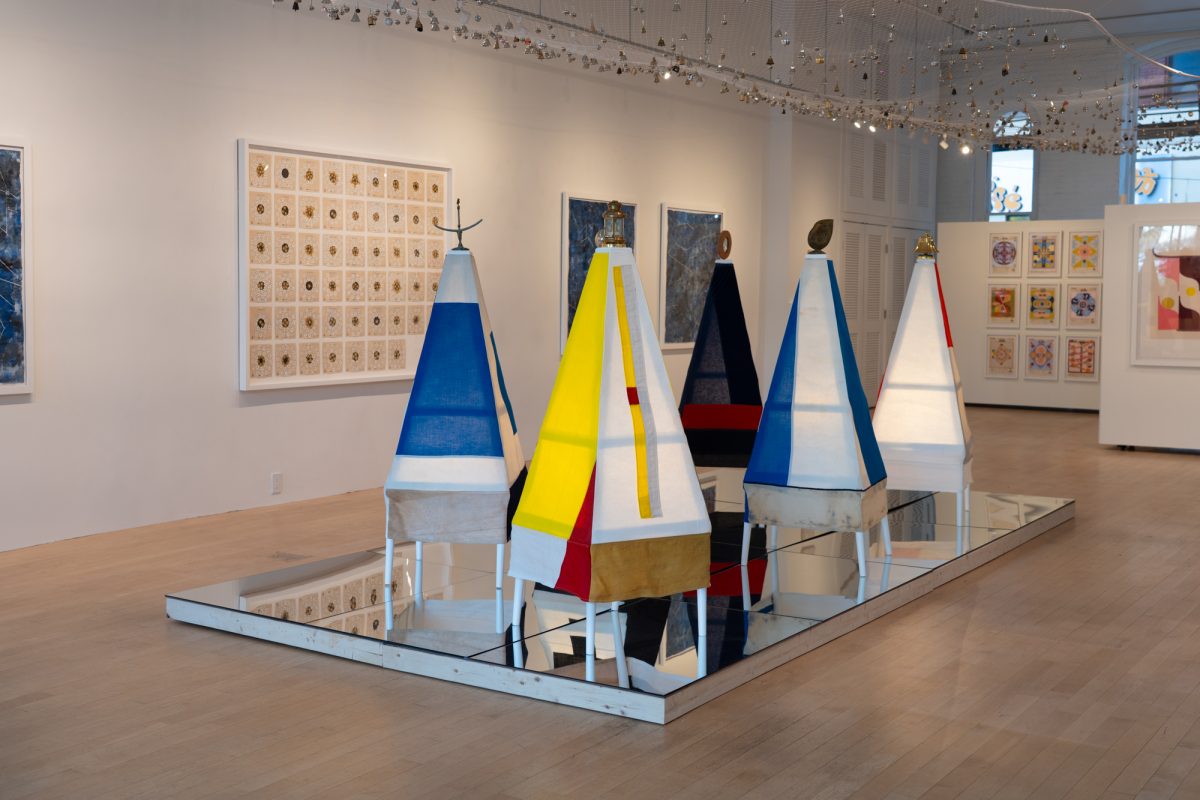
The exhibition, one of a handful of established residency programs for Black artists across the nation, features 60 works by 39 artists. It will run until Aug. 2.
The idea of differences and connection is central to the exhibit, which has art of several styles and materials spanning 49 years of work since its founding in 1977 by Simmons University professor Dana Chandler.
Today, it provides studio space to 13 artists and partners with various community organizations.
“Dana Chandler was really bedrock in terms of thinking, ‘How do I create a space in which artists of color … could be celebrated, as well as have a place where they can actually build and develop their practice?’” said current AAMARP Artist-in-Residence Marlon Forrester about the program’s founder.
Forrester, a graduate of the School of the Museum of Fine Arts, Boston, is one of the youngest members of AAMARP represented in the exhibition. He said he became involved with the program through a museum show called “Playoff X” at the National Center of African American Artists in 2012.
“It was a marker within the context of the Boston area, where folks knew about me and felt like ‘this guy has great potential to be one of the best,’” Forrester said.
Forrester’s piece in the exhibition is a six by six feet painting called “Warrior Dance.” The piece depicts a figure with a fabric object in one hand and sword in the other, surrounded by abstract patterns.
Forrester described the piece as having many layers, akin to an optical illusion if one looks at the center — a circular form placed at the belly button — for long enough.
“One of the things I am interested in is this idea of the dance, [which] is also about a spiritual connection to transformation. When I say spiritual, I mean the Black male body as a transformative thing and that within the context of people,” Forrester said. “We all come from different cultures, and we’re all connected to a land, and so the body becomes land.”
Though much of the ICA’s exhibit centers on the African American experience, artists of many different backgrounds have also contributed to the history of AAMARP, and their influence is reflected on the walls as well.
“It was very intriguing to find out that there was also a Chinese man and a white Jewish American man in this collective of African American artists as well, because they simply were all helping make the ship sail. So I thought that was beautiful,” said Viv Guilford, a visitor assistant at the ICA.
Pakistani-born artist Ambreen Butt has four works on display in the exhibit. Through connections with friends and a former professor at Pakistan’s National College of Arts, Butt put on an exhibition focused on South Asian art that was supported by AAMARP.
“AAMARP was one of those places that had always existed, and had nurtured a lot of artists, some of whom were my mentors and colleagues,” Butt said. “I’m one of those small flowers that was nurtured by the flowers that were nurtured by AAMARP.”
Despite having existed for almost five decades, sustaining the program hasn’t been easy, said Reginald Jackson, the director of AAMARP.
In 2018, Northeastern asked the artists to leave, and Northeastern would take over the program, determining themselves which artists got studios and how long they could stay, Jackson said.
WBUR reported in 2018 that Northeastern sent a letter to AAMARP requesting it “vacate the Jamaica Plain warehouse where they work by July 13.”
In response, AAMARP members simply refused to leave. Northeastern then changed the locks on the building, according to Jackson, who is also a professor emeritus of communications at Simmons University.
Jackson contacted former state representative Mel King, and Chuck Turner, a former city councilor, to help AAMARP’s cause.
“We got community together, and so we demonstrated outside the building. We painted a mural on the side of the building, and the mayor, Marty Walsh, got involved,” Jackson said.
After discussion, Northeastern agreed to not interfere with the program, except for placing security guards at the entrance to the studio. Artists could only work while security was there, which was originally for the majority of the day, according to Jackson.
But AAMARP has delayed membership for new artists, as it is unsure what the future holds for the program.
“We’re hoping that [Northeastern] continues to realize that they have a responsibility to the needs of the cultural community in which they reside,” Jackson said.
Northeastern University’s communications department did not respond to a request for comment before publication.
Jackson hopes the exhibition, which includes three of his works, will provide exposure and better understanding of the needs of the program.
Northeastern law professor Margaret Burnham visited the show and said she took away a strong sense of community from the art.
“I think it captures a collectivity in that community, and also an ability to reach out beyond practicing artists to those in the community who were associated with other forms of art, like dance and music, and to create a space where these artistic forms could speak to each other,” Burnham said.