
























































































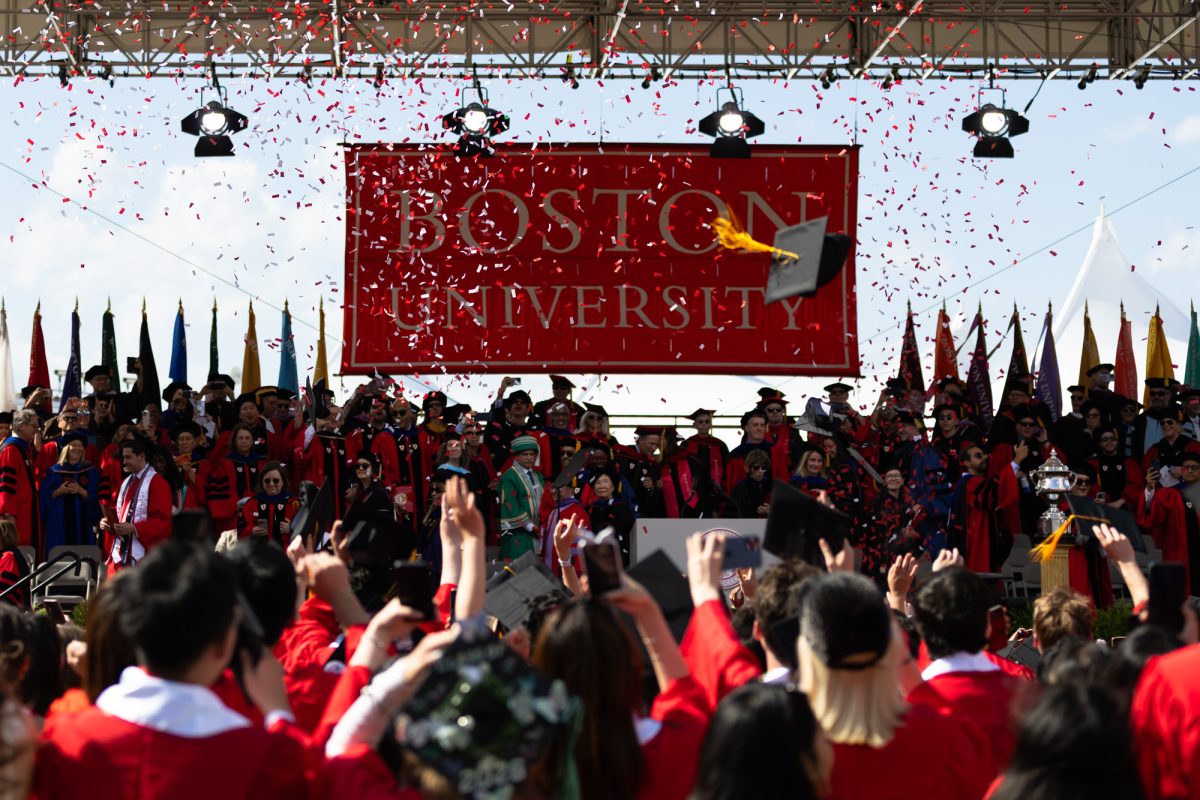







Before Jenny Gruber was the Future Systems Integration lead for NASA’s recent Moon to Mars mission, she was an undergraduate student studying aerospace engineering at Boston University.
It was while Gruber, who also serves as president of the BU Alumni Association, was at BU that she landed an internship with NASA, and she became certain she wanted to pursue a career in space exploration.
“I wanted to be involved with NASA since I was a little kid,” Gruber said. “The thing that really solidified it for me when I was an undergrad at BU was, again, my cooperative education experience. Once I came down [to Houston] and went to the mountaintop and saw the promised land, I knew this is where I wanted to be.”
Twenty-seven years after Gruber graduated from BU with a Master of Science in Aerospace Engineering in 1999, the Artemis II crewed lunar flyby mission launched — a key step toward getting humans to Mars. She has played a role in the Artemis campaign since joining the mission in 2018.
“We are doing something where the U.S. is leading nearly the entire world in exploration of another celestial body, and the kind of teamwork and cooperation that that takes is on a scale that we’ve not seen before,” Gruber said. “I think [International] Space Station comes close, but there are even more countries involved in the Artemis campaign.”
Artemis II was the second mission in a larger NASA effort to establish opportunities for human exploration of the moon, and eventually manned missions to Mars.
The mission launched April 1 and splashed down off the coast of California on April 10.
The four astronauts aboard the Orion spacecraft went farther from the Earth than any human has ever gone before.
This record-breaking space flight also marked a shift in focus for NASA missions, moving attention away from the International Space Station in lower Earth orbit and longer-range rovers and telescopes, which have been major efforts in recent decades.
BU sophomore Jasper Milstein, who double majors in physics and astronomy and in philosophy, said that current undergraduate students grew up during the tail end of the space shuttle program, a human spaceflight program from 1981 to 2011 which produced the ISS, the Challenger rocket and the Discovery space shuttle.
She said these eras didn’t have the same “level of grandeur” as the Apollo manned missions to the moon in the 1960s or the Artemis missions now.
“For the first time, especially in our lifetime as undergrads and our generation, [NASA is] focusing beyond Earth,” Milstein said. “Now what’s really cool about this is the first time we’re sort of going further again with manned missions.”
Eli Marlin, a cosmology research assistant at BU and College of Arts and Sciences class of 2025 graduate, said the attention surrounding Artemis II shows broader interest from the general population in continuing to fund space exploration.
“It represents, ultimately, a good thing, which is this reinvestment in space and human space flight,” Marlin said. “From a long term perspective, people are excited about the potential of what it could mean to have bases on the moon.”
Artemis II’s four-person crew is made up of three NASA astronauts — commander Reid Wiseman, pilot Victor Glover and mission specialist Christina Koch — and one Canadian Space Agency astronaut — mission specialist Jeremy Hansen.
Marlin said a key reason Artemis II has gained so much media attention is because people can latch onto the crew’s names and faces.
“A lot of the science that we do, especially with unmanned probes and stuff, it’s hard to get a big community reaction for because there’s no personalities,” he said. “I think it’s good to get people more involved, which is really important to continue to grow funding and build awareness around this kind of stuff.”

BU freshman Andrés Rodríguez, an astronomy and physics joint major, said there has been a positive mood among his classmates over the past few weeks because of the Artemis mission’s progress.
“I couldn’t tell you a single astronomy major, or at least the ones I know, who have been indifferent to this because it’s just so important for the field going forward,” he said.
Though Milstein, Marlin and Rodríguez said they are more interested in cosmology, the big picture study of the universe, rather than close-range space exploration, the Artemis missions open up pathways for their field too.
The Orion spacecraft used for Artemis is launched with NASA’s newly developed Space Launch System, which Milstein said could help cosmologists launch more telescopes that see further into the universe.
“This is only the second time we’ve used it, and it’s really different than what we used for the space shuttle,” she said. “NASA hasn’t built its own rocket since the space shuttle program finished, so that’s going to be a really cool thing to see now.”
Gruber said that in an era when Generation Z can’t watch entire TV shows without putting away their phones, it’s been “really special” to see her 17-year-old son put down his phone to watch media coverage of Artemis II.
“I hope that that’s representative of people in that late high school to undergrad sort of era, that they’re all feeling inspired by this and realizing that we really can do anything if we work together,” she said.
Gruber said she hopes by watching the coverage of Artemis II, young people can see the innovation that is possible through collaboration.
“I hope they’re inspired because I am,” Gruber said. “I know how this stuff works, and I’m still really excited about it. I’m still getting goosebumps when I’m watching the coverage.”
Rodríguez said seeing a successful mission like Artemis II reminds him why he is working so hard toward a career in astronomy.
“Seeing that what I study is very similar to the technology and engineering they needed to build that rocket and put it into space in the first place is very, very inspiring,” he said. “Sometimes the work I do is a lot and I get burnt out … but it’s things like these, it’s things like the Artemis II mission that really do remind me as to why I’m doing these things.”
Gruber said she hopes the success of Artemis II paves the way for NASA to get a sustainable moon base up and running over the next decade, then to shift their gaze further in the solar system to Mars.
“We get practice cooperating with all these different countries, and then we move on to the exploration of Mars,” Gruber said. “By the time people who are undergrads now are, say, mid- career, I would like them to be working on missions to Mars.”