













































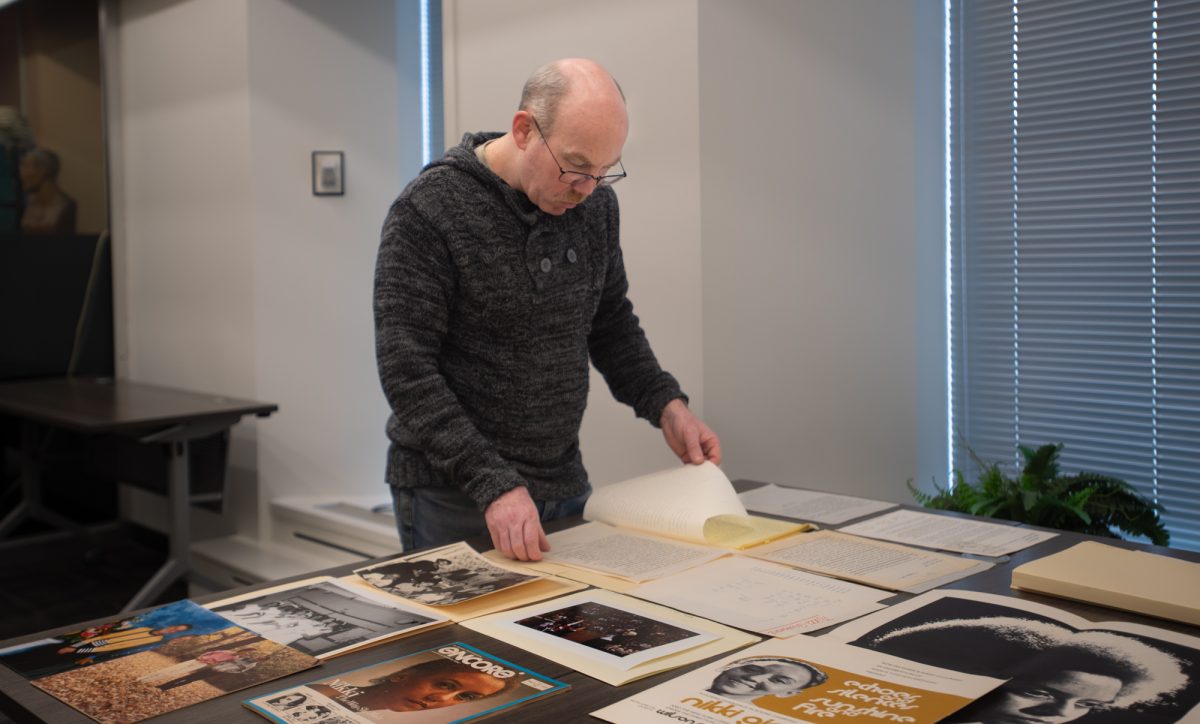
Boston University opened its collection of Nikki Giovanni’s personal papers to the public in February, revealing a tranche of never-before-seen poems, manuscripts, letters and other writings from the poet’s prolific life.
A prominent figure of the 1960’s Black Arts Movement, Giovanni explored race, gender and sexuality throughout her large body of work. The release of her papers comes more than a year after she passed away in Dec. 2024.
“Nikki Giovanni is a deeply thoughtful, incisive person with incredible humor,” said Jennifer King, an associate librarian at BU. “Her journals reflect that kind of ability she had to understand the world that she was in.”
Giovanni began a partnership with BU more than 50 years ago, after former BU archival director Howard Gotlieb wrote to her offering to hold a collection of her papers. Giovanni accepted the offer on the condition that the archive be released to the public after her death, BU Today reported.
“Giovanni recognized that there was a benefit to preserving the work that she did during her lifetime, but did not want to invite people into that space while she was alive,” King said.

Author of famed works “Black Feeling, Black Talk” and “Nikka-Rosa,” Giovanni was celebrated for her bold, unapologetic expression of the Black identity.
To consolidate Giovanni’s collection, archivists at the Gotlieb Center sorted through nearly 200 boxes of material from the poet’s correspondence, according to J.C. Johnson, a processing archivist at BU’s Howard Gotlieb Archival Research Center.
Johnson said the team worked to organize the archive in a way that preserves the papers’ original structure while making it practical for researchers to navigate.
“We’ve made good progress in that but we’re only a little ways into that process because there’s so much material,” Johnson said.
For archivists, the process of sorting through Giovanni’s life’s work has not only been shaped by the volume of materials, but by Giovanni’s presence within them.
Claudia Friedel, a research archivist at the Gotlieb Center, said Giovanni’s personality is what made organizing the archive especially meaningful.
“She’s very contemporary in a way that I think is really personal,” Friedel said. “Even though she’s a celebrity, I think she’s very much a part of people’s lives in a very deep way.”
That sense of personal connection extends beyond the collection. King said she met Giovanni in 2020 when King invited her to a poetry reading at Emory University. King said she was in awe of Giovanni’s generosity.
“She was not going to leave until she met every single person that wanted to have a book signed,” she said. “It was just incredible.”
King said meeting Giovanni made working with the archive an intimate experience.
“I really love her papers because it’s like spending more time with her,” King said.
The collection also highlights how Giovanni touched the lives of others. Among the materials are letters exchanged with other writers, fans of her work and even schoolchildren.
“I really love the joy that she seemed to get from engaging people about poetry,” Johnson said.
Friedel said she believes the archive would spark important research and creative exploration.
“This archive and Nikki’s work … is really a great foundation for bringing out some more creative projects with the archives,” she said.
The impact is already materializing in the classroom.
Fallon Murphy, a PhD candidate in American Studies at BU, is researching Giovanni’s archive. She said she wants to tell a story of how Giovanni’s archive came to BU and about her as a “writer and an incredible contributor to the Black Arts Movement.”
“She wrote quite boldly,” Murphy said. “Her archives really are a testament to that.”
Murphy is incorporating the archive into her writing seminar by having students examine three to five objects from the collection and write about how they contribute to the interpretation of Giovanni’s poetry.
The Gotlieb Center, which also houses the archives of Martin Luther King Jr., Sonia Sanchez and other important Black figures, provides a broader context for Giovanni’s work, Murphy said.
King said she hopes the archive will resonate with students, offering them a more personal way to engage with Giovanni’s work.
“I hope that the users of Nikki Giovanni’s papers are inspired … and allow the way she saw the world to help them see the world,” she said.
