


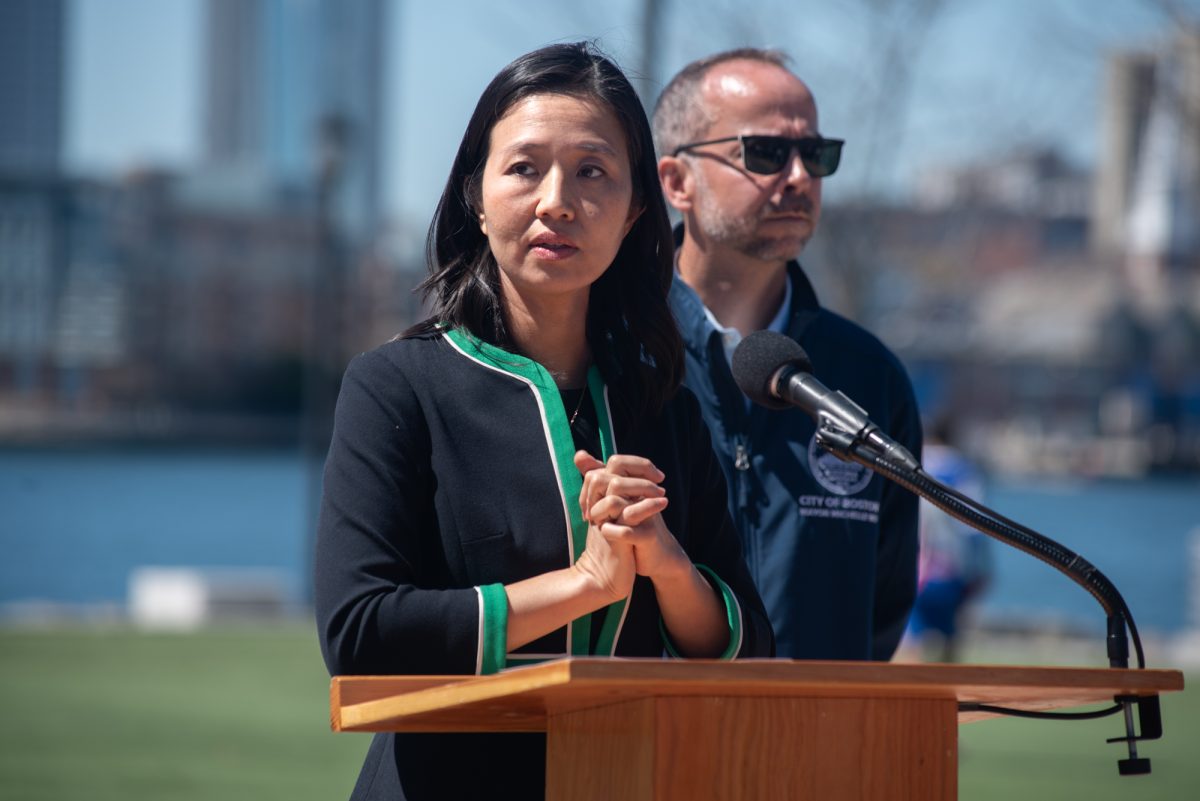





























































































Mayor Michelle Wu in March celebrated Boston Public Schools’ all-time high graduation rate of 81.3% — a 1.6% increase from the prior year.

But recent BPS graduates say the record-breaking graduation rate may be due to a change in graduation requirements.
Kevin Barrera, who graduated from the BPS Edward M. Kennedy Academy in 2022, a school within the BPS system, said it was “shocking” to hear the school had achieved that graduation rate, given that only 68 students in his 120-person class graduated, he said.
For Barrera, the most challenging part of the graduation requirements was the Massachusetts Comprehensive Assessment System, a set of standardized tests which BPS students formerly needed to pass to graduate.
The BPS class of 2025 was the first cohort no longer required to pass the exam, a change that some believe contributed to the district’s all-time high graduation rate.
Instead, in order to graduate, all Mass. public school students are required to meet the state standard known as the “Competency Determination,” through the completion of coursework.
Barrera said the competency determination graduation requirement is likely a better representation of student performance.
“It shows people’s ability towards more than just an exam, more of their flexibility towards work,” he said.
Boston’s 2025 graduation rate was the highest recorded since 2006, when the state began tracking the data, according to the Mass. Department of Elementary and Secondary Education, or DESE.
“Every demographic in our city saw progress, but the biggest gains were seen by our multilingual learners, whose graduation rates jumped by 5%!” Wu wrote in a Facebook post celebrating the achievement.
Wu credited the jump in graduation rates to investment in re-engagement for struggling students and addressing “absenteeism” in the classroom.
About 33% of all BPS students remained chronically absent last year, down from 34.6% the previous year, according to DESE data.
Joram Dade, a former BPS chemistry teacher and current BU doctoral candidate in educational policy, said in his 10 years as a teacher, absenteeism consistently posed a problem.
Dade said some students’ lack of attendance can be attributed to their living circumstances, particularly for immigrant students.
“In Boston Public Schools, you have a lot of people [who] are immigrants,” Dade said. “They come into the school system, and they’re just trying to situate how they’re going to live, let alone [go] to school…That contributes a lot of times to the absenteeism.”
Despite the record high graduation rate in Boston, students’ MCAS scores lowered statewide. Statewide, each 10th-grade student racial demographic saw a decrease in MCAS scores for English, math and science. The state’s Hispanic or Latino student group met 26% of MCAS expectations, the lowest among the other racial groupings.
Overall, only 42% of students met or exceeded score expectations.
Barrera said the low test scores don’t necessarily represent student performance.
“I prefer to see more people graduate than seeing lower rates of testing, because I feel like testing doesn’t personally show who they are as a student,” Barrera said.
BU junior Matthew Wuschke, a BPS Henderson Inclusion School alum, said there are positives and negatives to removing the MCAS graduation requirement. Wuschke said growing up in the BPS school district, he recalls the MCAS exam being a “big problem” for many students.
“It benefits those who aren’t good test takers and allows them to excel in things that are not specifically tests,” he said. “But also, it is quite concerning for those students who are doing poorly in class and they don’t show up, to skate past a standardized test that once used to scale where the students’ knowledge is at.”
City Councilor Julia Mejia, chair of the Education Committee which oversees BPS by creating public records to track student resources and investments, wrote in a statement to The Daily Free Press that she aims to provide a platform to “bring forward the voices of students, families, and educators.”
“As graduation rates increase, our responsibility is to understand what is driving that change, and whether it reflects meaningful academic progress across all schools and student groups,” Mejia wrote.
The Boston School Committee passed a $1.726 billion 2027 budget for BPS, with over 550 position cuts expected, intended to redirect funding toward direct English Language Learners and inclusionary education for Special Education students.
“There’s turnover at an astronomical rate in Boston Public Schools,” Dade said.
Dade said turnover affects Boston students, but “not as much as people think.” City students have a “leg-up,” he said, due to their unique experience living in an urban environment.
“Just being able to catch the subway from one place to another as a 10, 11, 12 [or] 13 year-old teaches you more about living and surviving than anything else could,” he said.
Even if MCAS scores fall, the shift towards course consistency over tests is a “good idea” that will result in greater city students’ success, Dade said. The MCAS graduation requirement was “not fair” to kids growing up in the inner city, who face unique challenges, he added.
“A place like BPS, you’re testing kids in an area that’s not where their strengths are going to lie,” Dade said. “They’re dealing with dynamics that are just different.”