










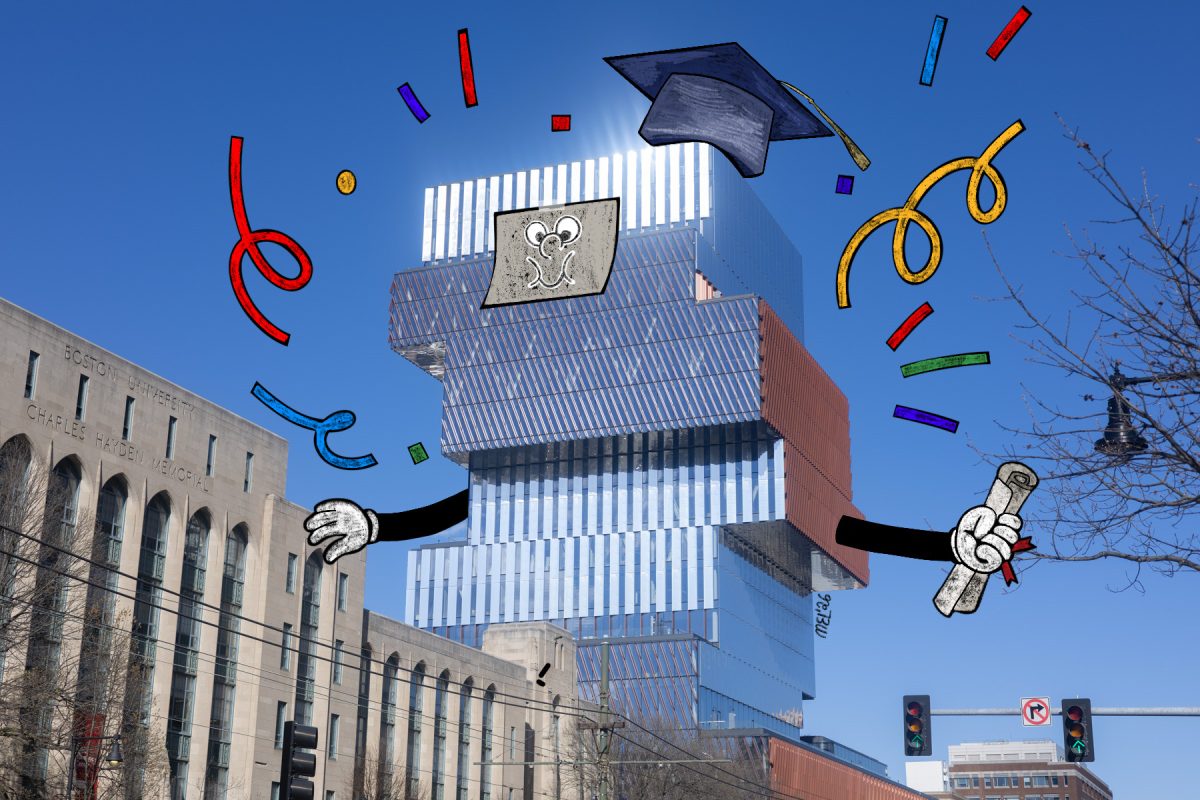







































































Boston University College of Fine Arts professors are beginning to engage with artificial intelligence in their curriculum. Students studying theater, visual arts and music expressed a range of emotions about this adoption — from hesitancy to outright refusal to engage.
Outside of CFA, BU has embraced the onset of AI by introducing AI-focused Master’s programs, AI courses and its own generative AI chat platform, TerrierGPT. CFA professors are now debating how to approach the rapidly-growing AI interface in their own programs.
“With being an artist, you kind of take a pledge to your community to support it. I think that utilizing AI kind of goes against that,” said Celia Drury, a junior studying painting and printmaking at BU.

Earlier this month, the Berklee College of Music received backlash from students after the school promoted a songwriting course, “Bots and Beats: AI and the Future of Songwriting,” according to an article from the Boston Globe.
Drury said she supports the Berklee students’ protest and believes investing in AI at BU is a “waste of our University’s resources.”
Other CFA students echoed similar sentiments about the University’s AI usage as it pertains to the arts.
Rufus Burnes Heath — a junior studying musicology and French — said he acknowledges the versatility of AI, but he does not see a meaningful purpose for it within his music degree.
“I’ve used AI to find sources or cite this source in Chicago, things like that, but that’s not an artistic process,” Burnes Heath said. “In terms of strictly what are the artistic processes and classes that I go through in the School of Music, AI just doesn’t have a place in that education yet.”
However, BU professor of music André de Quadros said he proposed a course to the CFA about the ethics of AI. He said the clock cannot be reversed on AI, so artists need to focus on how to use it appropriately.
“I do think that AI presents serious issues for us as an artistic profession, but also as teachers and scholars and so on,” de Quadros said. “I think one of the things we can do for our students is point the way to ethical and appropriate models for creative work using AI.”
The best way to adapt is through ethical education, de Quadros said, so students can learn how to “extend human creativity” using AI.
Clay Hopper, senior lecturer at the School of Theater, said he “strictly” views AI as “another tool in the toolbox.”
Hopper views AI as a new means to create a narrative, he said, so he implemented it into his curriculum.
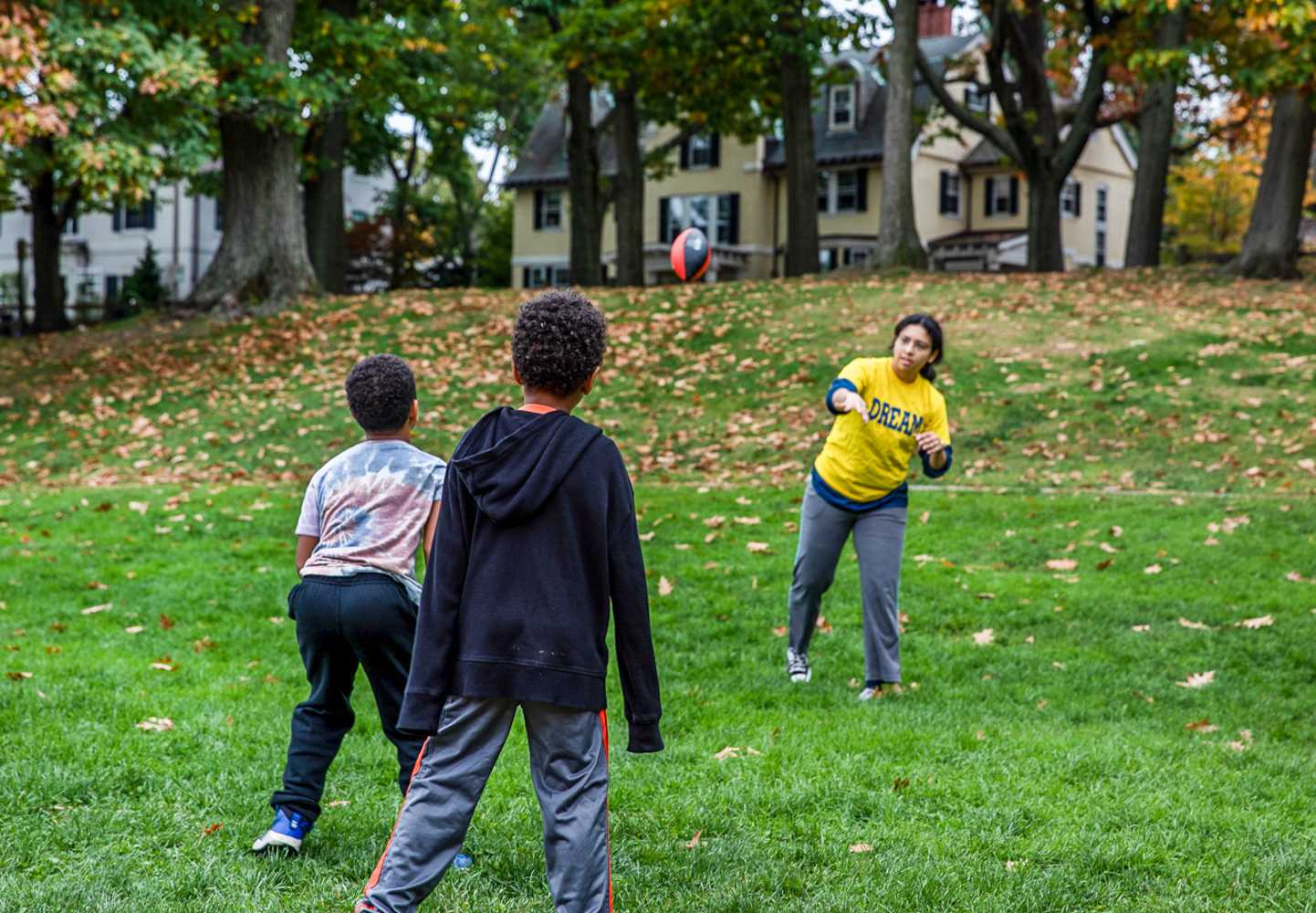
In October, CFA performed “Dream,” a shortened adaptation of Shakespeare’s “A Midsummer Night’s Dream” using Random Actor, a generative AI program. Random Actor — created by Hopper and James Grady — follows a performer’s movements to create an improvisational projection during a live show.
Students were unsure upon hearing about the program, Hopper said, but his students and peers were quick to embrace the software after firsthand experience with it.
“When you see it happen in front of you, there’s no mistaking what’s happening,” he said. “So, I didn’t have to work too hard to say, ‘Check this out. Watch what this can do.’”
However, Kara Zacharewicz, a CFA junior studying scene design, said they refused to work on “Dream” because they did not want their name next to an AI-associated production. Zacharewicz saw the show live and said the actors did well, but the show would have been better as a collaborative effort with visual arts and animation students.
“It was just so frustrating to witness because you could have achieved the same art, same effect, in some capacity, by just simply pulling those around you,” Zacharewicz said. “We’re doing this in the CFA. There’s a ton of amazing visual artists around here.”
Hopper said no matter what the change in technology is, people will still be at the center of the arts.
“[AI] will change it, something will occur, but it’s still going to be theater,” Hopper said. “No matter how sophisticated the models get, nothing can ever replace or match or come close to that artistic pulse that humans have.”
Drury said she acknowledges that generative AI can be a useful tool, but its effects on the environment and its complicated relationship with intellectual property make her personally opposed to using it.
Burnes Heath said attempting to use AI as a substitute in music education is not possible.
“Even if I wanted to use AI, if I wanted to use it for an assignment or for anything really, it just would not get me halfway to something that would be submittable to a professor,” he said. “For the artistic, musical things that we do, AI just doesn’t have a place.”


