
















































What are you wearing right now?
Easy question to answer, huh? What if I asked you what it was made out of?
If you asked me, I honestly wouldn’t know. Maybe polyester mixed with some spandex. Perhaps there’s some cotton thrown into the mix. Even as a fashion fanatic, I struggle with identifying materials.
But that’s precisely why one of my foremost goals for 2026 is to become more materially literate. By the end of this year, I hope to be better at not only identifying various textiles and their significance, but also how to work with them.
Although the concept of material literacy has slowly begun to gain traction over the past few years, it’s hard to find a unified definition for the idea. In my view, material literacy is essentially the ability to identify the composition of textiles and other material goods like paper, understand their development and interpret their cultural and historical significance.
It may seem like a strange goal among the ranks of typical New Year’s resolutions like “drink more water” and “get more sleep,” but it’s one I think we should all strive for this year.
I first learned about the impacts of fast fashion in middle school through repeated social media recommendations to watch “The True Cost,” a 2015 documentary that explores the social and environmental impacts of the fast fashion industry. I was absolutely devastated that something as important to me as clothing could be so damaging to others.
It was a big weight to rest on my 12-year-old shoulders, but I started doing what I could to be a better steward of our earth. I started thrifting and stopped asking my mom to buy me so much clothing. I went back to being a vegetarian, years after my first meat-free stint when I was six.
I really thought I could change the world. Middle school me wasn’t able to truly comprehend the role that centuries of oppression have played in creating the beast that is the fast fashion industry.
Now that I’m older and hopefully wiser, though, I understand that taking personal responsibility is just one step in the right direction — but it’s not the only step. I’m not naïve enough to think that simply learning more about the clothes we wear will magically make it all better. Still, I don’t think we can help facilitate true change until we understand the root of the problem.
On top of that, there’s a more personal reason I’ve been driven towards this quest for knowledge. Like so many young adults, I often find myself addicted to the dopamine rush that comes from mindless scrolling on social media. By working with textiles, I remind myself to step away from the screen and into the real world.
Improving my material literacy has already helped me expand my world view and learn more deeply about other cultures. I have learned about the ways in which cultural appreciation and appropriation have shaped fashion history.
One of the most interesting anecdotes I’ve learned so far is that the iconic style of the French Revolution was developed through the appropriation of Indian fabrics and silhouettes of French colonies like the Antilles.
At the same time, becoming more materially literate has helped me feel a deeper sense of kinship with my ancestors.
Like many Ashkenazi Jews — particularly Jewish New Yorkers — I come from a long line of tailors and garment workers. I’m surprised that I wasn’t born with a thimble on each of my fingers.
The first step in my journey towards material literacy is reading up the history and development of various fabrics. In addition to various academic works I’ve found online, I’ve loaned nearly every book I can find from my local library that concerns clothing and textile history.
Sofi Thanhauser’s “Worn: A People’s History of Clothing” is a perfect primer for anyone else interested in sharpening their textile knowledge. It’s an incredibly thorough look at the history of major textiles, from cotton to silk to synthetics. Thanhauser does a great job of covering the physical creation of various textiles, as well as the history of how they were developed and how they are used now.
The next book on my reading list is Sven Beckert’s “Empire of Cotton.” Because textile history books can be hard to come by, I’ve also been reading some online dissertations that are free to read on Google Scholar and other similar sites.
I think it’s rather ironic that most of the sources in which I’ve read about material literacy are not American. For a country with a culture that puts so much emphasis on categorizing individuals by what they own, we don’t seem to pay much attention to where our coveted designer goods come from — or where they go when we are done with them.
The second step in my journey towards material literacy is improving my ability to manipulate textiles. Specifically, I want to improve my hand sewing skills and expand my knowledge of fiber arts and crafts.

Unlike many young people, I learned to sew as a child — albeit not very well. When I was eight years old at sleepaway camp, I learned how to sew by making a cloth doll.
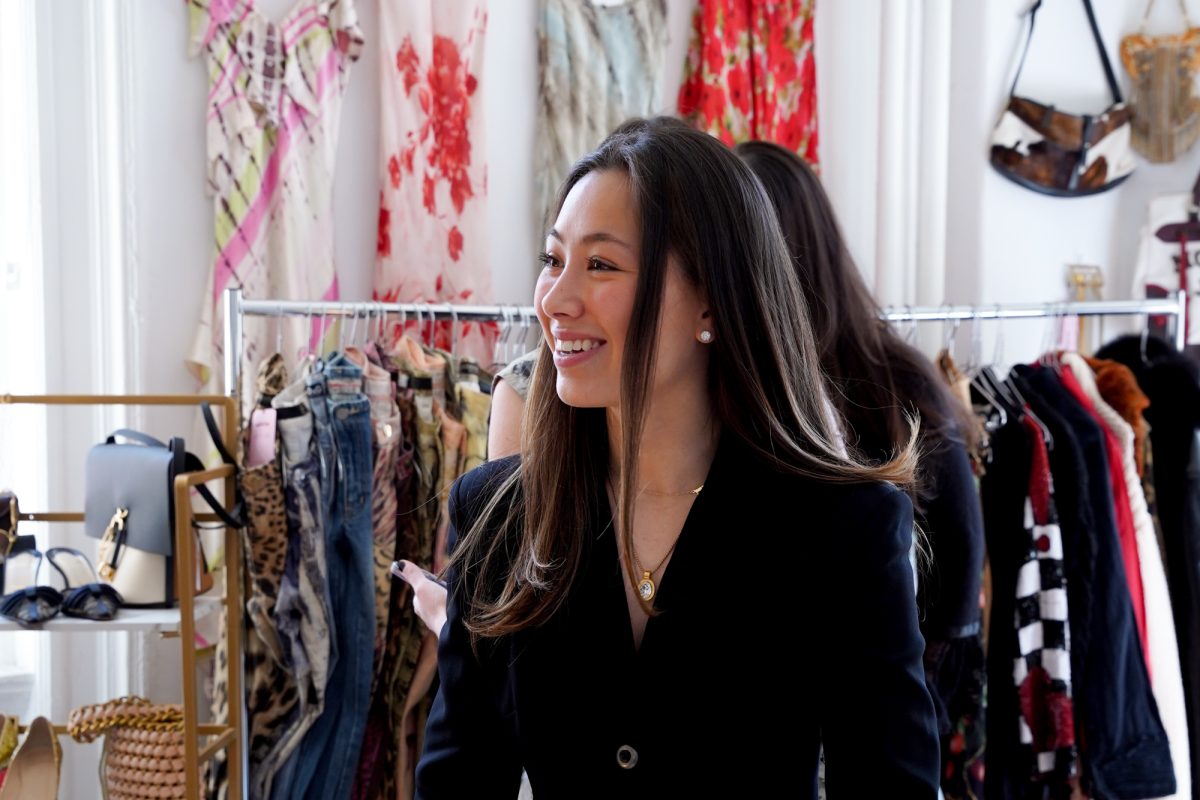
Over winter break, I tackled my increasingly large “To Repair” pile for my vintage clothing business. I sewed up seam after seam and reattached button after button. By the time I worked my way through restoring my inventory, I felt my heart swell with possibility.
By improving my sewing abilities, I reclaimed some of my own power. I am no longer at the mercy of ripped seams and expensive tailors. It feels pretty liberating to have that agency over what I can wear comfortably.
I also have been expanding my embroidery skillset and picking up other fun fiber crafts like felting. Like I said, it’s a great way to get me off my phone and the act of creation gives me a stronger feeling of fulfillment than mindless social media scrolling ever will. Plus, I’ve been able to create some adorable little animals to ornament my bedroom.
We may be most of the way through February, but it’s never too late to pick up a new goal. Consider boosting your material literacy. Maybe by the end of the year, you’ll be able to answer without question when someone asks what your outfit is made out of.