



























































































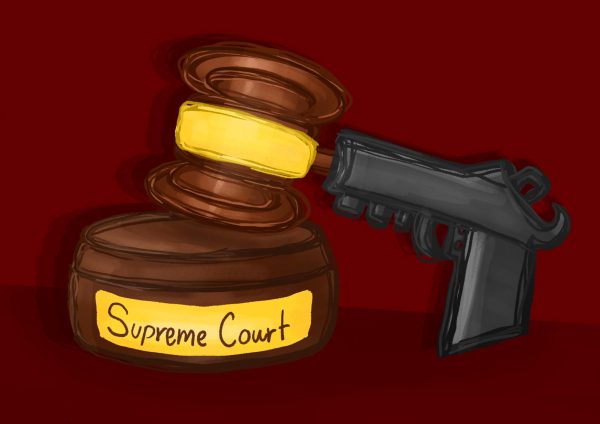
As government stakeholders at all levels continue looking for ways to mitigate the horrific mass shootings plaguing the U.S., the Supreme Court, led by Chief Justice John Roberts, expanded gun ownership rights in a 6-3 ruling in the 2022 case of the New York State Rifle & Pistol Association Inc. v. Bruen. This case held that there is a historical aspect to gun control laws, meaning there must be a clear pattern of historical examples of the desired level of regulation. If not, the law cannot stand.
Brandon Koch and Robert Nash lived in Rensselaer County, New York — a rural, but populated part of the state — and were seeking unrestricted concealed carry permits from the State of New York for general self-defense purposes. However, state law held that in order to get this permit, one must show an “atypical” need for self-defense. What is considered atypical was determined by a licensing officer, and Koch and Nash were denied unrestricted licenses on this “atypicality” basis.
And so, Koch and Nash — the petitioners — sued the State Police Commissioner and a State Supreme Court Justice — the respondents, alleging that their Second Amendment rights were being unfairly restricted.
The petitioners won out. New York law already prohibits open carrying firearms, and from this, Koch and Nash convinced the Supreme Court that the difficulty of obtaining an unrestricted concealed carry permit was so burdensome that it worked as a de facto removal of Second Amendment rights.
The Court also narrowed the scope of these cases by removing the use of means-end scrutiny from Second Amendment cases. This is when the Court balances the rights of an individual against the goals of the government. It requires that if you are to remove someone’s Constitutional rights, it has to be for a clear reason and the law in question has to be concisely written to achieve this clear goal. Before, if there was no relevant historical analog, the next step was to use intermediate scrutiny and see if the law still works.
The Court removed that second prong of the test, so now it is history or bust for prospective gun control legislation. New York’s law was overturned, and the gun control laws of five other states are now in jeopardy because of this ruling.
The Court’s overall opinion struck down any use of means-end scrutiny in gun control cases, in part due to fears of judicial activism when using balancing tests such as intermediate scrutiny. Justice Kavanaugh argued that with such a central right as gun control, we cannot leave it up to a potentially biased judge to decide who gets their guns.
Balancing tests are used in other Constitutional cases, including First Amendment cases. Balancing speech cases is difficult, and yet, it is done often. What makes the Second Amendment so different?
It is apparently an offense to stipulate when and where guns can be carried in order to prevent the loss of human lives, but perfectly reasonable to allow the judicial system to decide what speech is and isn’t worth saving. Each case can and should be taken in its own right, but it is difficult to avoid playing the comparison game when such hypocrisy is at play.
In the end, the Supreme Court didn’t rule that balancing tests should be used — the 2nd U.S. Circuit Courts of Appeals did — but that doesn’t lessen the validity of the ruling at all and should not have been used as a detractor as it was in this case.
Justice Breyer wrote the dissenting opinion, and was joined by Justices Kagan and Sotomayor. He argued that the question is best left up to the Legislative Branch. The issue of gun control is not an easy one, and while guard rails can be put up by the Judicial Branch, legislators should be the primary decision makers in such a nuanced topic.
Along with not being legislators, Breyer also said judges are not historians either. The new, more stringent requirements regarding historical analogs means everyday judges and attorneys need to become incredibly familiar with history and past laws in order to make and try their cases.
The historical record for this case was suspect at times, and this is the Supreme Court — imagine how muddy the waters will be when the same situations play out in lower courts.
I can understand the Justices are very concerned about Second Amendment rights, but removing means-end scrutiny leaves states almost defenseless. There is no room for debate or innovation in future legislative practices, just a cold and unmoving burden in the way of potential problem-solving. Removing alternative methods like balancing tests is taking the scalpel right out of a surgeon’s hands, and the cancer of senseless gun violence will become terminal for far too many people before this issue is resolved.




Leah • Mar 16, 2026 at 11:45 pm
Very interesting 🤔💭