










































At first glance, baby boomers and payphones may seem like things of the past. But on Boston University’s campus, you can now interact with both.
Outside Pavement Coffeehouse, a plaque on a phonebox installed during the first week of March invites people to “call a boomer” as part of a social experiment.
When someone makes a call, a similar phone labeled “Call a Zoomer” located in a senior housing complex in Reno, Nevada rings, initiating a conversation spanning nearly 3,000 miles and multiple generations.
The box is run by Matter Neuroscience, a company whose mission statement is “advancing human happiness for our collective good,” according to its website.
The phone booth creates conversations between baby boomers, currently aged 62 to 80, and members of Gen Z, aged 14 to 28. Out of all age groups, both young and old adults have experienced the highest levels of loneliness.
“Research shows that loneliness is more harmful than lack of exercise, excessive drinking, and even excessive smoking,” the plaque reads.
Calla Kessler, a social strategist for Matter Neuroscience, said that by having conversations and fostering relationships, people can alter their brain chemistry to live a happier life.
“If we can just have a friendly connection, even if it’s brief, you’re gonna get your brain to activate feel-good neurotransmitters more frequently than if you’re just at home, not talking to anybody,” she said.
According to Kessler, having regular conversations is essential for both physical and emotional health.
“We’re social beings, and we need each other on a molecular level,” she said. “We do that so much more easily when we’re with others.”
The idea to start the phonebooths emerged from discussions on creating something that would “inspire people to find common ground with one another and perhaps with people they wouldn’t expect to connect with,” Kessler said.
“The payphones were just a stroke of luck and planning,” she added.
She noted that similar “Call a Republican” and “Call a Democrat” boxes in California and Texas, respectively, have already received a warm welcome.
According to Kessler, the Democrat and Republican phone booths received 350 connected calls and 400 voicemails, the vast majority of which were positive.
“You might expect such polarized groups to get into it because it’s so easy to do so on social media,” she said. “But I think when you actually put a human to [another] human on the phone … it’s less likely that you’re gonna just be mean. There’s another living, breathing human being on the end.”
Kessler said Matter Neuroscience decided to continue the project afterwards. This time, they focused on bridging a generational divide.
“There’s a lot of intergenerational distance, especially in Western culture,” she said. “We’re just not very connected to our elders.”
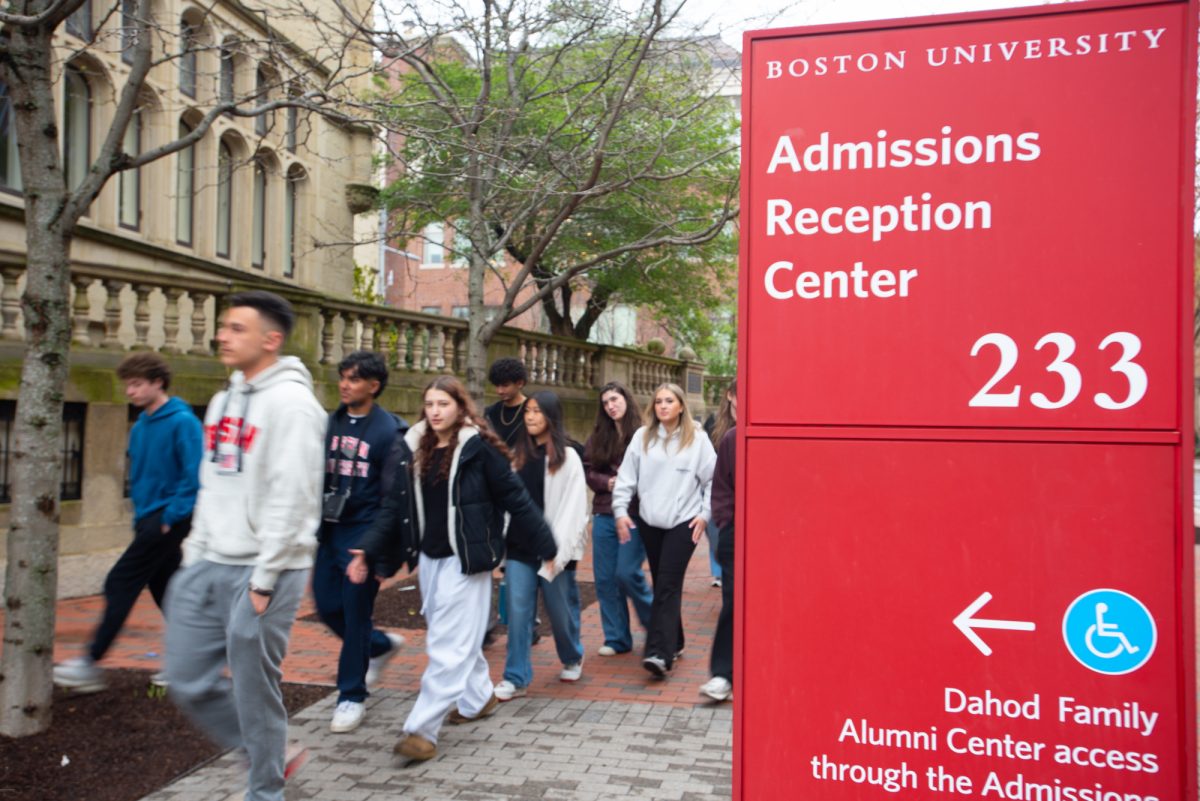
For the Gen Z phone booth, Kessler said the company chose Boston University’s campus because of its name recognition, “high walking traffic” of college-aged students and its connection to the city.
While Trissha Sivalingam, a second-year graduate student, is close with her grandparents, she said she doesn’t interact with boomers regularly in her college life.
”In my day to day life, I don’t know if I … interact with boomers a lot beyond my professors,” she said.
So far, Kessler said, callers have been having open, sweet conversations, including sharing advice and connecting with one another.
“I think that the senior folks are really enjoying a chance to talk to the younger generation and vice versa,” Kessler said.

Santiago Yunes, a freshman at Emerson College, said the phonebooth’s anonymous and spontaneous nature made him feel more comfortable making a call.
“You don’t know who I am, I don’t know who you are,” Yunes said. “You can just come here and talk.”
The phone box exists under a month-long agreement between Matter Neuroscience and Pavement, Kessler said. But if both Pavement Coffeehouse and the senior home agree to continue, Kessler said they were willing to make it a permanent fixture.
“We’re always open-minded, and we definitely like to hear from our audience [about] what sounds interesting to them,” she said.
Kessler said she hoped the phone booth would highlight the dangers of loneliness and Mission Neuroscience’s prerogative.
“Even if we don’t get [one] more call, I think the amount of buzz we’ve gotten around it has increased people’s awareness of the need for connection,” she said.
Yunes said being lonely is “understated” because it’s hard to admit as a problem.
“No one really talks about how hard it is to feel lonely,” he said. “You walk around people all the time, you’re surrounded by people in class and everything.”
Sivalingam said seeing the phone booth made her question whether her independence might also be loneliness.
“I definitely took a step back just to be like, ‘How much of my independence do I take a lot of pride in? How much of that loneliness impacts the way I ask for help?’” Sivalingam said. “I never really thought of it as loneliness. I’ve always thought of it as independence in my head.”
Even seeing the box while walking by could prompt people to reflect, she said.
“It’s more impactful than seeing something on your algorithm because it’s real, it’s in person,” Sivalingam said.