






















































































What if you could see what goes on in a single cell, without damaging it?
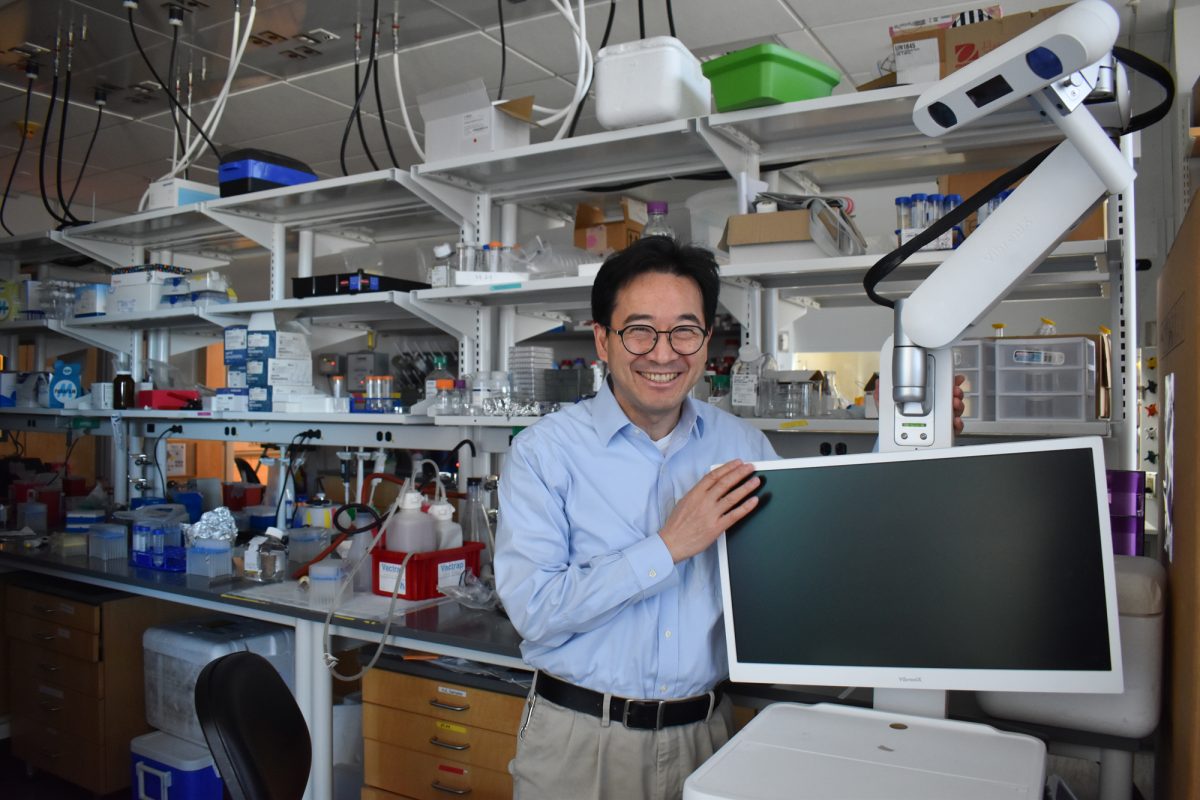
Boston University Distinguished Professor of Engineering Ji-Xin Cheng, who has been researching this topic for over a quarter of a century, has used technology to map out chemical reactions in tissue and to detect prostate cancer. He is now working on issues related to Alzheimer’s disease and antibiotic resistance.
Cheng was elected into the 2025 class of Fellows for the National Academy of Inventors — the highest professional distinction awarded exclusively to inventors. It’s reserved for researchers “tackling the biggest and most pressing issues of our time,” according to the National Academy of Inventor’s website.
Cheng’s research is focused in chemical microscopy, a high-speed, high-sensitivity imaging process that can reveal both chemicals and chemical processes within materials.
Chemical microscopy differs from traditional microscopy through its direct observation of molecules and their processes without the fluorescent dyes traditionally used in molecular “labeling” techniques.
The problem with those dyes, Cheng said, is that they only highlight known molecules in the cell, and they can’t reveal anything smaller than the dye molecules, like proteins or cholesterol.
“You can also pack a cell with a dye, but you don’t know what’s in the cell, or what’s the cancer in the cell, or how [its] chemicals change during a disease,” Cheng said in an interview. “This means we need a next generation tool [so] we can directly visualize the molecule or the cell.”
Chemical microscopy allows researchers to “discover unknown, hidden signatures inside tissue,” Cheng said.
“The chemical microscopy, which we developed, is using the intrinsic signal from molecules,” he said. “We can visualize biomolecules in a label-free manner, and we can differentiate different molecules.”
By pioneering “next-generation chemical imaging tools,” Cheng said he is giving researchers a new lens to understand diseases like cancer, Alzheimer’s and antibiotic resistance.
Fourth year chemistry PhD candidate Rylie Bolarinho, one of Cheng’s students, said that with this type of chemical imaging, researchers get an “extra dimension of information” inside the cell.
“We’re able to really see at this level what’s really going on inside the cell,” Bolarinho said. “Not just the image, but also the chemical processes.”
The ability to observe chemical processes inside cells without introducing disruptive dye molecules enables researchers to advance in disease prognosis and diagnosis, fifth year electrical and chemical engineering PhD candidate and another of Cheng’s students, Guangrui Ding, said.

Ding said the long term goal is to use the technology to “save more people’s lives.”
“If it can help us study fundamental processes in biological systems, maybe we can develop some new biomarkers to label the disease process,” Ding said. “I think this should be the ultimate goal of our communities.”
BU Professor of Chemistry and Electrical and Computer Engineering Chen Yang, who, alongside being a scientific collaborator, is married to Cheng, said chemical imaging technology has important biomedical applications.
“Using those microscope[s] and looking at the living system allows us to understand how disease develops [and] how disease progresses,” Yang said. “Identifying the early biomarkers for early diagnosis also helps us to have effective treatments.”
In addition to his work in chemical imaging research and development, Cheng is a cofounder of VibroniX and Photothermal Spectroscopy, two businesses which “focus on the commercialization and delivery” of chemical microscopes.
“If I can convert my innovation into a product that many, many people can use… Then the impact will be much bigger,” Cheng said.
In addition to his natural curiosity regarding nature and mechanisms behind it, Cheng said a major motivator that drives him is the mission of helping mankind.
“I want to use my strength [and] my brain to invent new things, or to develop a new method to help improve people’s health,” Cheng said.
Bolarinho described Cheng as a dedicated and supportive teacher and advisor.
“He’s so dedicated to the research and to us as a group, to be able to advance this research in microscopy and chemical imaging,” Bolarinho said. “He has a real interest in what we want to do with our career and how we can best pursue that.”
Ding said Cheng is a creative scientist and a patient, kind advisor.
“After several years of his hard work in this community, he developed a lot of new technologies and enabled a lot of new findings,” Ding said. “He deserves this award.”
Under Cheng’s guidance, students will go on to leave a valuable impact to the community, said Ding.
“He has already achieved a lot in this field, but I think there’s still a lot of unknown areas waiting for him to lead us [as] a team to explore more [of] these unexplored areas,” Ding said.
Cheng will be officially inducted as an NAI Class of 2025 Fellow at the annual conference in June in Los Angeles, California.
While completing so much hard work has been fulfilling, being honored as a NAI fellow is not the most rewarding aspect of his work, Cheng said.
“The real rewarding part is that my work helped other people and helped improve people’s health,” Cheng said.