































The White Snakes Projects production company presented “White Raven, Black Dove,” a science fiction fantasy space opera about life after “the sixth mass extinction,” from Friday to Sunday at the Strand Theatre on Columbia Road.
”White Raven, Black Dove” is set in the far future on a scorched Earth. Life is practically nonexistent, and the only remaining humans have split into two tribes: the Onyxs, who are largely people of color living under the surface and dwelling in caves, and the Silvers, who are predominately white and living on the surface.
Both tribes face death daily, as they have to avoid radiation from the sun and toxic gases excreted by the Earth’s surface. In order to survive the harsh conditions, both tribes have engineered a second layer of “embryonic skin” given to every newborn that protects them from radiation — but at the cost of making them blue.
Before the show began, Founding Artistic Director and Opera Maker Cerise Lim Jacobs introduced the show and thanked everyone for coming.
Afterward, the lights dimmed, and a projection of singular cells was shown on the central screen. Two figures completely covered in red and blue paint, respectively, entered from either side of the stage. It was Y Chromosome Adam and Mitochondrial Eve.
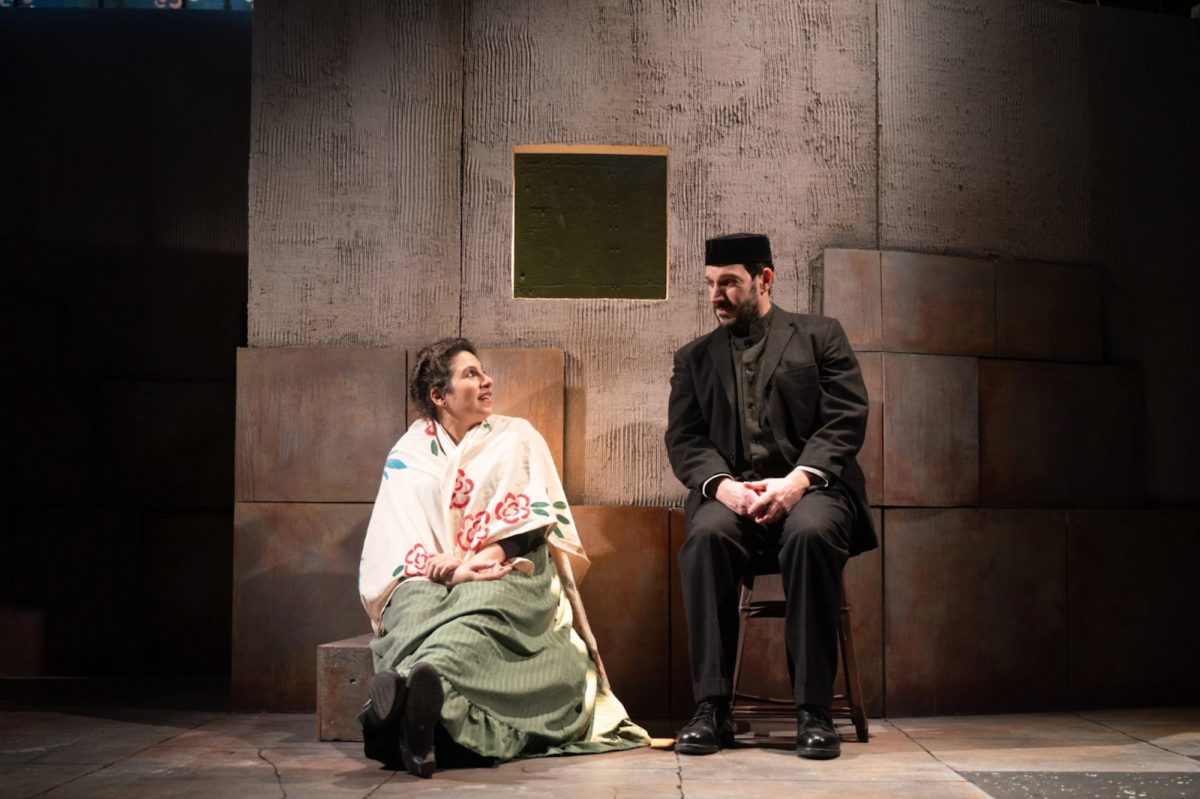
As I found my seat in the middle of the eighth row, I made note of the beautiful theater. The set was simple but effective, consisting of two staircases on either side of the stage that led to a raised bridge.
Littered throughout the set were large projection screens displaying CGI artwork from students at Lesley University College of Art and Design, which helped in understanding the complex worldbuilding. One large circular screen helped establish setting changes and exposition, which allowed for the limited set to act as a good base for the artwork — similar to that of “The Great Gatsby” on Broadway, which also utilized similar projection technology.
The prologue consisted of Mother Earth grieving the death of the planet and fearing the new dystopian lives of her children, the remaining humans. The characters’ booming voices set the tone for this somber story about racism and climate change.
The surreal premise required a large amount of exposition, which I found somewhat hard to sit through. The nature of operatic music is slow and drawn out. Science fiction fantasy is a genre that requires a lot of explanation — and providing it through opera singing was lethargic.
However, once the prologue was over, I began to enjoy the performance a little more.
The story begins with an introduction to the main characters: Kora, Peristeri, Dove and Raven. Kora and Peristeri are siblings who tend to the birds in the Onyx society. In their culture, birds are sacred symbols of life and nature.
Raven and Dove are birds. Raven is often teased and bullied for being a runt — unlike his brother Caw, who has been chosen for a sacred ritual to find a green leaf signaling the Onyx’s opportunity to rise up against the Silvers. Dove, whose sister Devine was also chosen, cannot speak and tries to find her voice throughout the opera.
Throughout this exposition scene, I was in awe of the talented vocalists. Each performer carried their songs with incredible precision and confidence. Dove’s high-pitched voice perfectly resembled a young dove searching for its crow, and Raven’s comedic timing surprisingly meshed well with the dramatic nature of the opera.
My favorite moment came in the first act, when Raven helps Dove find her voice. I found Raven and Dove’s voices worked very well together, and their bond was wholesome. It was heartwarming to see two characters who were regularly put down for their shortcomings eventually overcome them. That’s a story we can all connect with.
Overall, though, Act One was a little slow. The lack of subtlety in the dialogue and lyrics made me feel a little bored. The odd pacing had the consequence of leaving many of the characters underdeveloped with somewhat weak motivations.
Act Two begins with the main group of Kora, Dove and Raven reaching the Earth’s surface, a hellish landscape. After a battle, it is revealed the foundational truths that bind the society together are not at all what they seem, ultimately supporting what I believe the opera’s overarching thesis is — race is a social construct.
Further tragedy ensues as characters try to grapple with these newfound truths, leading to a hopeful conclusion that one day the world will be free of all the racial ties that bind.
Act Two was a little bit more enjoyable than the first. There was much more humor, which was needed after the gravity of events in Act One. The chemistry between the actors seemed a lot more natural, and the introduction of new characters was a welcome addition, allowing the audience to understand the perspective of the Silver tribe.
However, Act Two was much shorter, which resulted in — again — terrible pacing. The ending felt incredibly rushed, with multiple themes being hamfisted and a death that I felt was entirely unnecessary.
Thematically, this story is somewhat heavy handed. The racial commentary surrounding the idea that race is a social construct and a byproduct of evolution deserved more nuance and care, in my opinion. Ninety minutes was not enough to fully explore the conflict between the Onyx and the Silvers. It felt quite rushed, and to be honest, I was even confused at times.
Visually, the production embraced contrast, which was also in service of the themes discussed in the opera. In the animated art portions, darkness combined with bursts of white light in projections on the stage as well as silhouettes of birds in flight, reinforcing the opera’s ecological themes.
The use of costuming, particularly the embryonic second skin, found a good balance between symbolism, realism and creativity, reminding the audience of both the opera’s futuristic setting and its present-day relevance.
The musical compositions were unique, employing unusual instruments like an electric guitar, which matched well with the science fiction genre. The performers were captivating and incredibly talented, with some even playing multiple roles.
This opera thoroughly surprised me, and I was eager to come back to my dorm and funnel my thoughts into this review. In the end, I left satisfied with a greater appreciation for the opera, and I hope to see more from this production company in the future.


Zara • Sep 30, 2025 at 11:29 am
Amazing article! Loved the Gatsby reference