































































































Last week, Gary Sheffer, a former COM professor, spoke as a guest at my COM CO 101 lecture where he discussed his successes and failures during his 13 years as the chief communications officer of General Electric.
My peers were either listening on the edge of their seats or falling asleep. I was somewhere in the middle of that spectrum — until Sheffer shifted his discussion to the hot topic on everyone’s minds: AI.
He pulled up ChatGPT and asked it to generate a hypothetical crisis communication statement from And

y Byron, the former CEO of Astronomer, following his infamous Coldplay kisscam incident.
Within milliseconds, it spit out a three-paragraph statement riddled with em dashes. Awestruck by its quickness, Sheffer said something along the lines of, “This is why AI is your friend! It did that in five seconds, and that would’ve taken me three days!”
A rumble began to make its way around the lecture hall. Our eyes, no longer half-open, squinted as we read the statement. It was completely wrong.
The GPT response dressed up as Byron expressed no remorse or moral obligation. He instead expressed gratitude for the ways he was able to bring the internet together.
Our professor stated that this demonstration showed why we actually shouldn’t use AI and thanked Sheffer for taking the time to speak to our class. Still confused, we applauded nonetheless, and class was dismissed.
The bewilderment in that lecture hall followed me back to my dorm. With every head-scratching thought, I wondered if this would be the future of communication — a creative fate dictated by robots.
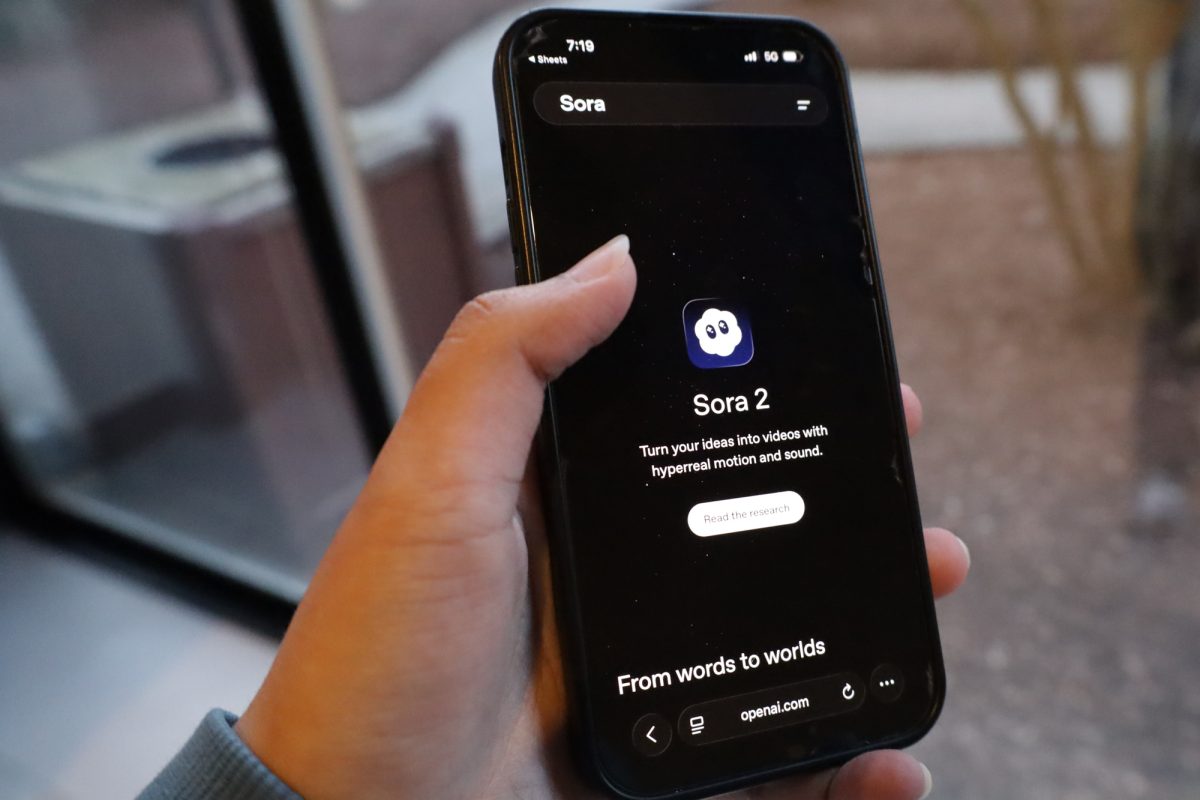
Being a first-year college student in 2025 means living in the world of AI, whether it’s having conversations with my friends about its ethical implications, seeing my professors artificially animate historical figures and colleagues in lectures or watching peers have full conversations with ChatGPT in the front row of my philosophy class.
According to a survey conducted by Walton-GSV-Gallup, almost half of Gen-Z use AI on a regular basis. Another survey conducted by Quinnipiac University reports that 83% of Gen-Z are concerned AI will reduce younger generations’ ability to think for themselves.
While about six in 10 adults under 30 say the increased use of AI in society will diminish creative thinking skills and the ability to foster meaningful relationships, according to a Pew Research study, only four in 10 adults over the age of 65 share these beliefs.
While these attitudes appear contradictory, they are ultimately linked by the unique moment in history we find ourselves in. As we continue to exist in the shadow of the COVID-19 pandemic — which led to increases in working-from-home and remote work — entering an increasingly automated workforce makes the world all the more difficult to grasp.
On one hand, we are told to work smarter, not harder — that AI is a tool we must wield to our advantage. On the other hand, it violates the morals and values of much of our generation, excavating and hollowing the human experience.
Under American capitalism, efficiency is survival. And we must stay afloat by any and all means necessary. By greenlighting everyday AI in the name of efficiency, we invite it to bleed into other parts of being human. We sacrifice creativity, friendship and feeling just to keep our heads above water.
When AI-powered efficiency becomes the core of our livelihoods as Americans, everything emotive bends to it. And to make up for that lack, AI becomes humanized, filling in the gaps in every area of living. We are already watching this happen with the rise of the wearable “Friend AI” technology and the normalization of using ChatGPT for therapy.
Unlike Gen Z, older generations grew up in a world where efficiency was still a distinctly human goal. While they had other factors that threatened their ability to establish themselves professionally, such as navigating the internet for the first time and adapting to globalization, they could always fall back on humanity — both their own and each others. So, for people like Sheffer, AI is just another frontier that exists to advance our lives.
Gen Z, however, is facing the frontier of AI, which stands as a barrier to an established and stable life in an increasingly unstable world. If AI truly is the new frontier, we have to ask ourselves the impossible question: Is it better to break through it or forgo it completely?


Velana Valdez • Nov 7, 2025 at 10:41 am
Great piece! I think realistically AI won’t slow down in the slightest even though it has demonstrably unethical and negative social impacts. Super important to bring attention to these topics though, and its interesting to see where older generations lie on this stance.