














































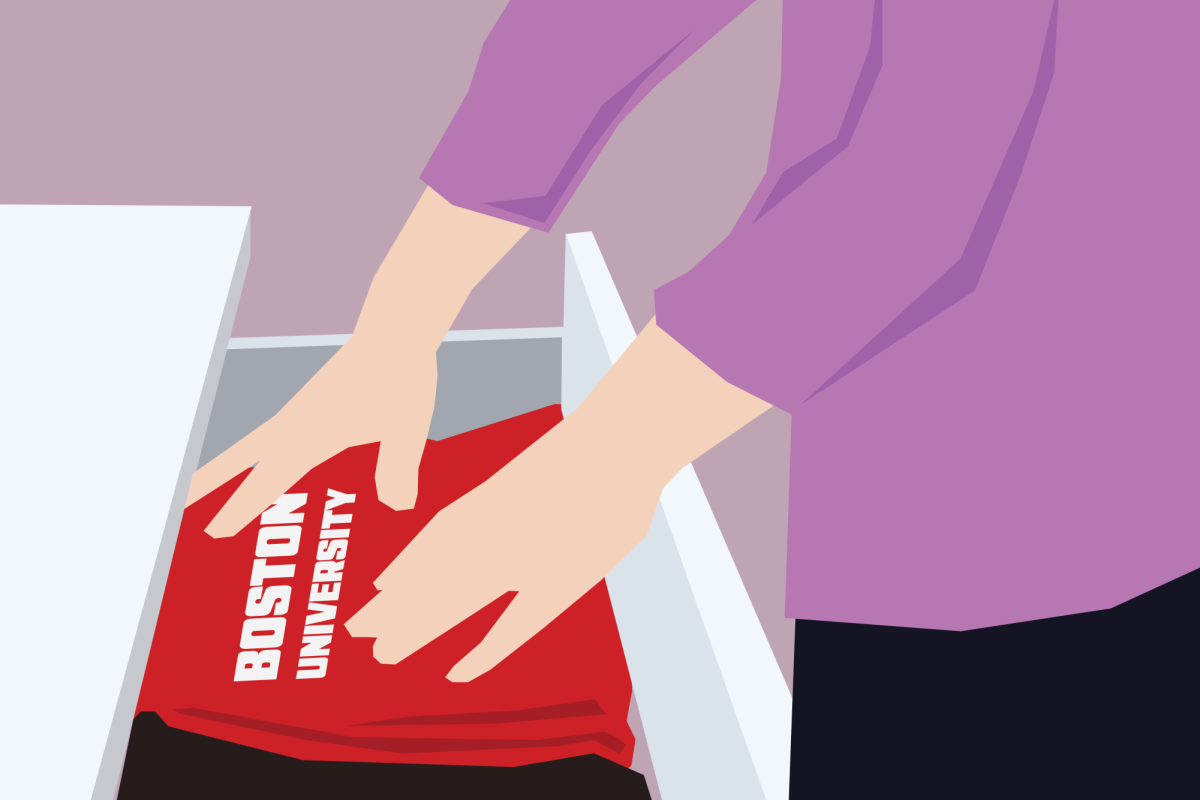






I’ve been running this column for almost two years now, which means many of you probably assume I’m some kind of dating expert. But here’s the truth: Having my heart broken a few times doesn’t make me any more qualified on the topic of dating than the strangers I pass on Commonwealth Ave.
What does set me apart, though — and what gives me this odd “third eye” for navigating love — isn’t the number of relationships I’ve had. But the way love has shaped me, strengthened me and at times, shattered me.
And that’s why I chose the title for this piece. Because somewhere along the way, I realized that so many of us are constantly searching for the “next” love —the next partner, the next spark or the next distraction.
We chase newness, thinking it will fill the ache from what we’ve lost. But the truth is simple: We need to spend more time tending to the love within our lives, rather than scrambling to replace it.
Loving others
The first person who ever taught me how to love — beyond instinct and biology — was my mom.
She was my first hug every morning and my last kiss every night. Now she sits on my dresser in a porcelain urn trimmed with gold and red roses. It’s a surreal thing, holding someone who once towered over you and cradled you in their arms in the palms of your hands.
But losing her didn’t wipe away everything she taught me — least of all the standards she drilled into me, the ones I sometimes quote in this very column. But it did change me. It changed the way I understand love, trust and the risks we take when we hand our heart to someone else.
Grief warped love for me. It made me cynical. It made me angry.
It pushed away the people who tried to help. It made me isolate myself because I couldn’t accept love from anyone who wasn’t her.
How could love feel real from someone else, when the person I wanted it from most was gone?
And then there’s that quiet sting — watching other people receive the kind of unwavering love I can no longer have. I never thought of myself as jealous, but grief introduces you to strange new shades of envy. You start to begrudge moments that others don’t even realize they’re lucky to have. You feel guilty for the envy, and then guilty for the guilt.
And yes — this has made me a flawed friend and partner at times. But it doesn’t make me a bad person. It makes me someone still learning where to set down the weight of a love that no longer has a place to land.
In that same breath, I can also say that grief has expanded my capacity to love. It sounds contradictory, I know. But losing someone doesn’t only close you off — it forces you open in ways you don’t expect.
I’ve leaned into emotions I once thought made me weak. I’ve let people in more deeply than before. My appreciation for connection, in all its fragile forms, has grown richer and more intentional.
Whether you’ve lost a parent, ended a friendship or walked away from a partner you thought was “the one,” the goal is not to replace what you lost. You couldn’t, even if you tried.
The goal is to make space for new love, different love and unexpected love — not as a substitute, but as its own distinct thing. Because love is not one-size-fits-all.
The love you feel for a partner is different from the love you feel for family, or friends, or the people who show up for you in small, quiet ways. Each connection has its own texture, rhythm and temperature. No two loves are identical.
And when we finally understand that, we stop chasing a feeling we used to have — and start appreciating the ones standing right in front of us.
Loving yourself
Most importantly, the person you are with the most and must also love the most is yourself.
And that can be hard most of the time. I personally find myself funneling most of my love into other people because I don’t know how to put it into myself. I feel guilt, regret and feelings of failure that make it hard to tip that funnel of self-love into my aorta.
But it’s not impossible — and that is what I want you to remember. The most important relationship you will ever have in this life is with yourself —not a boyfriend, girlfriend, partner, sibling, child or relative.
The love we share begins from within. And I’ve found through my own experiences that if you constantly try to avoid who you are and what you’ve been through, you will never feel satisfied in any other relationship you hold.
I’ve always had a complex relationship with myself — it has ebbed and flowed throughout the years. It has been strengthened by new connections and weakened by loss — but as doubtful as I can be sometimes, I still love the person I have become.
The end of a relationship will never be make or break for us if we can always remember that we have the ability to carry on and be there for ourselves.
Love is complex

That’s an understatement — love is like a Rubik’s Cube that you’ve mixed up so far beyond solving that you contemplate peeling the stickers off and just being done with the damn thing.
But it’s still worth it.
You will go through periods where you feel like it’s not, but please listen to me when I say it’s only temporary.
Sometimes there are no happy endings. No matter what, you will lose someone or something that meant the world to you. Or maybe it will just be different.
As Emily Giffin puts it in her book, “Love the One You’re With,” that’s what it all boils down to. She describes love “not as a surge of passion, but as a choice to commit to something, someone, no matter what obstacles or temptations stand in the way.”
Giffin wrote that “maybe making that choice again and again, day in and day out, year after year, says more about love than never having a choice to make at all” — and I thoroughly agree.
Open your eyes, look at what’s in front of you. Don’t forget to glance back.
Remember your loss, hold it close. And still, choose to move forward and allow yourself to love those you are with.